The Third Man and the Cold War

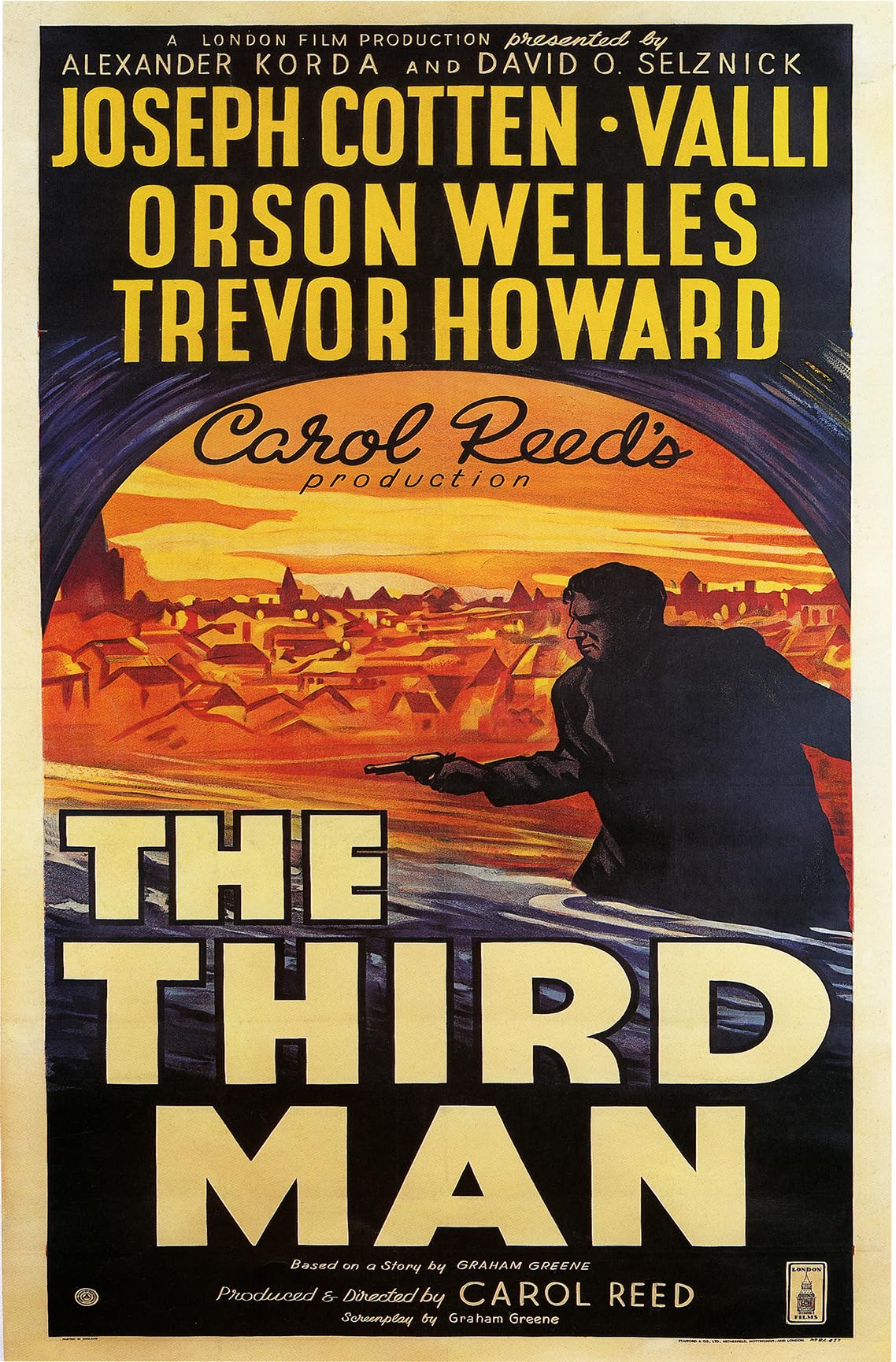
You were lucky to watch one of the great films in the history of cinema. It features: A powerful story and script by the English writer Graham Greene, brilliant filmmaking by the director, Carol Reed and his cinematographer Robert Krasker. Add to this the captivating score by the Austrian zither player Anton Karas and unforgettable acting by Orson Welles, Joseph Cotten and Alida Valli. In a survey of British film critics some years back it was chosen as the most highly rated of British films ever.  For my part, I find it unforgettable as cinema. For the purposes of this class, I think the film is enormously useful. The film is a remarkable window on a pivotal moment in the history of postwar Europe.Amazon.com: - The Third Man Vintage Orson Welles Movie Poster - 11x17:  Posters & Prints

It was shortly after the war, 1947 or 1948, that Alexander Korda had the idea of making a film about occupied Vienna. Korda, a popular film producer in Britain, had emigrated from Hungary himself. He asked Carol Reed to begin work on the film. And Reed, in turn, invited Graham Greene to visit the city and write a script. Greene spent weeks in Vienna in February of 1948, researching the occupation, the blackmarket, and the cafes. He wrote a novella that would be the basis for the screenplay. It’s a great thriller – full of unexpected twists and brilliant characters – that also presents some powerful moral dilemmas.

Big Screen Berkeley: 'The Third Man' — The perfect film?

We can watch the film for the story – but as historians we should also see it as a product of a time and place. The emergence of the Cold War was the backdrop to the making of the film. While Greene was writing his novella, officials in Prague, Czechoslovakia were purging non-Communists from the government. While the film was being shot in Vienna, the Russians blockaded the city of Berlin, another city under four power control, ratcheting up tensions with the western powers. When the film first appeared in theaters in Britain and the U.S., officialsfrom both countries were hammering out the details of the North Atlantic TreatyOrganization.

The filmmakers set out to make an entertaining thriller, not a political speech on the Cold War. Nonetheless, we can read the film as a distinctly British perspective on the global tensions that strained Europe in these years.


Back to Weimar? A Comment on Murderers Are Among Us

I want to share just a few words on this extraordinary film, Wolfgang Staudte’s Murderers Are Among Us (1946). Warning: spoilers ahead.

The film comes out of Berlin and the immediate aftermath of the war – and it tells a story that, much like Rome Open City, reflects on the experience of the war. Susanne Wallner returns from a concentration camp looking like she just got back from a Mediterranean cruise. She discovers Dr. Hans Mertens living in her apartment. Not your classic meet-cute. He’s scarred by the war, crazy, disheveled, a drunkard. He spends his days wandering the rubble-strewn streets and visiting the cabarets, while she begins to draw again. Of course, Suzanne falls in love with Hans, but he doesn’t know if he can love again. So, #1, we have a love story.

But it’s 1945 in war-scarred Berlin. Things aren’t going to be so easy for these lovebirds. It turns that Hans’ old captain is still alive, Ferdinand Brückner. Alive and thriving in postwar Berlin, turning helmets into cooking pots and making good money. We hate to see bad guys prosper. Story #2: revenge. Will Hans kill Brückner for the crimes of war?

We can take time to discuss what the story means. I want to say a few words about the film’s style. The lighting, the cinematography, the soundscape all deserve some close attention. We’ll take a look at some striking compositions: canted shots, shadows looming over figures, evocative lighting, high angles. Staudte made his film in the shadow of the Nazi experiment (more on this when we get together), but he emphatically rejected the film styles of the Nazi period. His film harkens back to the styles (and the themes) of Weimar (that is pre-Nazi) German cinema (think the films of Fritz Lang, for example). The truth is out there, but it is obscure, hard to read. And moral corruption is everywhere. How do we start again? The answer for Suzanne and Hans – see #1 – is romantic love. The answer for Staudte seems to be a return to the filmmaking world of the 1920s and 1930s.

The Old Italy and the New – A Comment on “Open City”

Roberto Rossellini’s Rome, Open City (1945) opens like a thriller — soldiers in the street, a man hunt, tense music, a rooftop escape — and closes like a national fable — with children marching into the future to build a better Italy. In between we are served up a story of repression and resistance (and suffering and persistence) in the face of an oppressive German occupation. The plot is driven by a series of character studies: Pina, who comes across as a force of nature; the reluctant resistance operator Don Pietro, who brings humor and humanity to the film; the compromised Marina, who plays the role of (im)moral exemplar; the Christ-like suffering of Manfredi, and many others. It is driven by powerful scenes: the shooting of Pina (0:57:00), the seduction of Marina (1:13:27), the torture of Manfredi (1:27:07), the execution of Don Pietro (1:40:12), and more. And it centers on a number of themes: resistance and betrayal, women’s roles, father figures, moral decisions. Any one of these characters or scenes or themes could be the subject of its own essay.

Italy, as I told you in class, has a complicated history when it comes to the Second World War. Italy was the birthplace of the fascist movement in the aftermath of WWI, and Mussolini was an ally of Hitler in the effort to dominate Europe and the world in WWII. By the time of the “open city” of Rome, in 1943 and 1944, Italy was occupied by the German Army which faced an Allied invasion from the south. For the most part, the moral valences of the characters come in black and white, good and bad, but there are Italians on the bad side (such as the police chief), Axis soldiers on the good side (such as the Austrian deserter). Nonetheless, this is a film about resistance, a film that seems aimed to redeem Italy from the stain of fascism.

We could write another comment centering on the roles of women in the film. “How are the women?” Manfredi asks (0:11:42), and he names a theme of the film. Pina stands as a powerful maternal figure. She slaps Marcello around a bit, and pulls on his ear (0:37:50), but everything tells us that this is what a good mother in Italy in 1943 should be doing. That she is unmarried and pregnant gets a bit of notice (from Pina herself), but doesn’t seem a problem in the world of the film. Her sister, Lauretta, and her friend, Marina, are another story altogether. Somehow or another they’ve gone bad (in the world of the film) working in a cabaret, entertaining German soldiers, and giving themselves over for the promise of drugs and goods. Rossellini was playing on old images, the contrast of the holy mother figure and the degraded prostitute and turning them to the moral purpose of a restored Italy.

priest in antique store

Another kind of commentary could direct our eye to the mise-en-scene (or the art design). For the most part, the settings of the film are simple and bare. In the background of Francesco’s apartment we see a map of Lazio, the region around Rome (0:13:36). On the wall of Major Berman’s office there is a map of Rome (0:05:29) . There are moments of strange, almost expressionist shadows on the wall, as in the shot of Don Pietro at his desk. In one scene, the setting and the props stand out as something different. In the first part of the film, having accepted the assignment to help Manfredi and the resistance, the Priest Don Pietro enters an antiques shop cluttered with statues and furniture (0:19:31) and asks to see Francesco (Pina’s fiancé). What follows is a funny little moment as Don Pietro looks at the statue of San Rocco looking in the direction of a statue of a naked woman (0:20:31). The priest shows his embarrassment and turns the statues away from each other to protect the eyes of San Rocco. Have some modesty, he seems to say. It’s a funny moment that relieves the tension of the partisan mission that Don Pietro has taken on. But it also seems to resonate with the story of the film. Here is an old Italy of statues and trinkets, expressed through the setting of the antiques shop. The new Italy is behind a door and down the stairs; it is the Italy of the partisans who are organizing resistance to the German occupiers. It says something important, on the part of Rossellini, that the Catholic priest and the Communist partisans will work together.

Somehow old and new will have to work together to rebuild Italy. And so, in the last image, we see the children marching together as the dome of Saint Peter’s rises behind them. They are off to rebuild Italy on more solid ground.

Welcome to History 209!

This is the course website for History 209: Europe Since 1945: Film & History. Here you will find the syllabus, the course schedule, and much more. We’ll use this space as a blog to comment on films and the news from Europe.

Note that we will also use Moodle to upload assignments, to access readings, and to share the grade book.

Looking forward to getting started!

All the best, gks